Thursday, November 3, 2011

Which Side Are You Really On?


“The 99 versus the 1” - this is both a convenient rounding and a misnomer about just who is battling who. The mainstream media and the Tea Party have been minimizing the Occupy movements as the actions of a few professional agitators with a handful of hippie soldiers. I was watching CNBC the other day, and while they did conduct an interview with Michael Moore, he was not allowed in the building. After the interview ended, one of the conservative on air personalities said, “I agree with one thing that Michael Moore just said; 2 years on and no one has been punished for the financial crisis.” He continued, “But I agree with absolutely NOTHING else."

There is some serious cognitive dissonance at work when someone can agree with the root of the problem polarizing America, and the world, but yet claim to completely disagree with the problem’s obvious origin, that there are any steps needed to resolve it, or acknowledge the devastating effects it has had on innocent people. This attitude is all too common, especially among the aspirational middle and upper classes (what few of them are left). What is the source of this massive disconnect? I believe the answer can be found in our class system; rarely is it discussed, but it plays a pivotal role in keeping different groups from seeing that they are all in the same boat. Here is the modern class system as I see it.

1. The Underclass

This class is easy to define and describe: they will be found working at minimum wage or low-paying jobs, or are just plain out of work. This class has members who were always poor but are increasingly being joined by the underemployed (those working as Walmart greeters who ‘left’ their careers as comfortable middle managers), the newly unemployed, and those working whose wages have not kept up with inflation and who dropped into the category of ‘poor’ by all known definitions.

There are now about 6 unemployed Americans for every new job opening in the United States, and the number of "chronically unemployed" is absolutely soaring. To put the jobs issue into perspective, Harvard University accepts roughly 7% of applicants. At a national “Hiring Day” in May, the apparently even more prestigious fast-food chain McDonalds only accepted 6.2% of applicants. There simply are not nearly enough jobs for everyone, and the poorest class is joined in alarming numbers on a daily basis.

2. The Middle Class

The middle class is less tangible: definitions vary, and the estimated size ranges from 25% to 65% of the population. A popular definition describes a comfortable standard of living, economic security, and work autonomy, but few of these seem to apply to anyone in America’s new reality. Certainly not to those making between $25K and $100K per year, the range for “middle class” income suggested by the Drum Major Institute. One thing is certain, however; despite this group's aspirations, their ranks are rapidly dwindling. The nebulous nature of its definition can only temporarily hide this fact.

Even a few of this article’s 22 statistics showing the destruction of this class are unnerving – for example, that from 2001-2007, 61% of all income growth in the US went to the top 1%, and most of that to the highest fraction. Similarly, the top 1% now own twice as much wealth as they did 15 years ago. Our polarization of wealth is now worse than during the Great Depression. Taken as a whole, the statistics are terrifying. It is now unequivocal that this vast part of the population is being rapidly eroded, yet there is a general refusal to face this fact. This pig-headed avoidance of the deep problems within the American economic system is exemplified by Republican presidential hopeful Herman Cain, who recently told the unemployed and poor, “Blame yourself!”

3. The Indentured Elite

I began this post with questioning the math of 99% vs. 1%. The reason I thought that this was oversimplified was because I, and a number of my peers, are considered ‘rich’ –this is a flawed perception, so I decided to break down the numbers even further. What I call the ‘indentured elite’ is a class that is rarely, if ever, talked about: so infrequently, in fact, that I may be coining the name here. They are lumped in with the ultra-rich but with an entry point of just $250K to the top 1.5%, their interests could not be more different. A nice house and car, the occasional luxury holiday, and access to credit may visibly differentiate them from other classes, but these are basically meaningless.

Their status is just as insecure as the other groups – perhaps more so, due to their ability to over-leverage – and they are just as powerless. Trapped, they do the bidding of the true corporate and banking elites, either by resigning or deluding themselves to it. If the other classes who side with the oligarchs are their foot soldiers, these are their sergeants and generals. Indentured elites, unlike the true rich, did not benefit from the financial crisis. Much like the middle class, while this group’s ranks have shrunk since 2008, those that remained actually became poorer in relative terms than the real rich, who made an absolute killing during the recent calamity.

4. The Top 0.01%

These are the money masters – the (often hereditary) uber-elites who make markets, give orders to politicians, and have been engaged in a decades-long campaign to actively siphon off wealth from all of the other classes. You have nothing in common with them. I have nothing in common with them. Most CEOs or multi-millionaires have nothing in common with them - even Warren Buffet and Bill Gates, people who made their wealth in one generation, have been pushing vigorously to redistribute for the greater good.

The top fraction are the people who have rigged the game hopelessly in their favor, grabbed everything within reach, and then used the media to convince the average person that America is a meritocracy and people who fall behind have no one to blame but themselves. They hide their theft by creating a system that benefits only them, all the while claiming that the whims of the markets and economy are inevitable, like a force of nature. They will not stop until someone stops them.

People need to stop deluding themselves about where they stand on the economic food chain and face the harsh reality. Americans are led to believe their country has the wealth equality of Sweden. It’s actually more like Nigeria, Uganda or the Philippines. If all of the underclasses – from the poor to the indentured elite – can’t unite on that common ground, then no one will be able to stop this runaway train.


Tuesday, October 25, 2011

It's Time for Unity - We're All Greeks Now


Two years ago, when the world’s ails were all being placed squarely on the shoulders of the lazy, deadbeat Greeks, we wrote that the plight of the common Greek was not dissimilar to the plight of the average person anywhere else in the world. We drew many parallels to other Western countries, in particular my beloved Canada. While some commenters were appalled that I dared to compare Canada to Greece, even in the best of the G7 nations the similarities are becoming discernable. With all that has changed in the world, I encourage the reader to go back to the post and see if it has a stronger resonance for you than it may have had last year.

It definitely does for me. Although the media continues to attempt to trumpet the ‘Blame Greece’ theme, it no longer rings as true for many people. For those Greeks that I encounter here in Canada who have adopted a timid and apologetic tone, I invite you to read the wonderful article published here:Link. In it, the author details the money flow and that those being both blamed and charged for the indiscretions of a profligate society, are not the culprits. Every Greek should read that article to be able to educate all those who continue to remain blind and who parrot the negative bull.

Hold your head high, as it is the Greeks that have been leading the charge, and whose Olympian torch is now sparking the ‘Occupy’ movement. In a previous post, we listed the benefactors of the Greek National debt and proffered the list of those who were being asked to pay for it, in order. The injustice of who made the money and who was left to pay was as obvious then as it is now, yet we still encounter the mass ignorance of the Tea Party, their followers, and those who rely on headlines and media sound bites to understand the world we live in.

It was just over two years ago that the fear started raging about Greece’s economy. A country whose GDP was just 2% of Europe’s was going to singlehandedly take down the E.U., and with it the world, if draconian austerity measures were not immediately adopted. All Prime Minister Papandreou could offer was, “If we do not adopt these changes it will be catastrophic”. They were forcibly adopted and the results have been catastrophic. Greece’s GDP grew in 2008, all be it modestly, at a rate of 2%. Since the magical cure-all of austerity was rammed down the throats of the Greek commoner, the Greek economy has shrunk at an increasingly alarming rate (2009/-3% 2010/-4%) and unemployment has reached the absurd (2011/14.85% 2011 est.).

Remember that austerity was preached as the solution to Greece’s economic ills, and that the financial spin doctors had forecasted that growth would inevitably follow austerity. Combined with lowered spending and the sale of state assets, this strict fiscal diet was the cure-all that would bring Greece back from the brink and save the modern world. It’s also not a coincidence that it was these same financial wizards who cooked the books to allow Greece entry into the Euro in the first place, and who stood to lose the most from the logical path of a structured default. Austerity was never going to work, as we had already learned from Argentina’s case and so many others. Austerity was always going to lead to further ruin, but the banks would be able to collect their due for a little while longer.

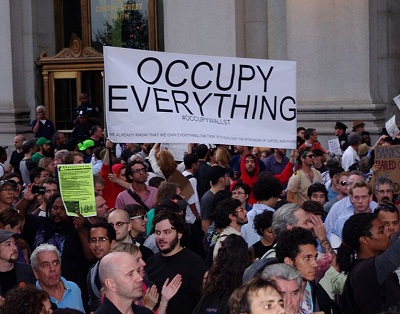
Just over a month ago, a small group of the disenfranchised – aka the ‘99%’- began a peaceful protest that was quickly dubbed “Occupy Wall Street”. While it is primarily a U.S. movement, its roots can be traced back to the fight that the Greek people have been waging for over two years, the same anger and frustration at an unjust global system that inspired the Arab Spring. The Greek protests were dismissed by the media and European elites as anger from a lazy people being deprived of their cushy welfare state – never mind that the indolent Greeks work more hours per year than the Germans. In the Arab world, the protests were spun as a simple plea for Western-supported democracy. Neither explanation was correct – the roots of the protests were about something much larger, and deeper.

When you ask people what Occupy Wall Street is all about, you get few concrete answers in return. Who are their leaders and what are their demands? It seems to be about nothing, the media complains, perplexed at how to explain the movement. Is it about political corruption and lobbying? Is it about greedy bankers and their golden parachutes? Is it about unemployment, and the growing inequality and income disparity in America? Is it about the iron grips of Big Oil and Big Pharma? It is about the loss of civil liberties and the multi-billion dollar surveillance state?

There are no easy answers. The movement has no one single leader and no single demand. But it would be a dangerous mistake to dismiss the protests as ‘about nothing’, especially as they have found a deep resonance, and spread like wildfire throughout the globe. If it was truly about nothing, would more and more people be joining daily, pitching tents, sending money, and, at least in New York, even ordering pizzas for the campers? The answer is simple yet wholly intangible; it is the global collective consciousness finally being awakened from slumber, throwing off the torpor induced by fear and lies and the distractions of the media. And as it awakens, it begins to see the world with crystal clarity, like a child who simply knows right from wrong.

In 2008, the whole world nearly collapsed and the prescribed tonic was just more of the same with a sprinkling of tax on the poor (directly or through increased deficits). Good people lost their jobs, the world’s youth has been robbed of its hope and all the while the rich just seem to get richer and continue to be rewarded for the carnage they have created. The movement is like a child that does not know what is wrong; it just knows that something is very wrong. It will cry until it gets what it wants, though it does not necessarily know what that is. Now picture a child that is 300 feet tall and weighs 500 tons…what happens when that child doesn’t get what it wants? Anger is usually not far behind the crying, so someone better figure out what the pacifier is, fast. It is everywhere and in front of us and it surely isn’t the same old thing.

And so, just as the Greeks, as the pioneers of this movement, have been screaming enough for over two years, the world is now saying it as well. ENOUGH! ENOUGH! ENOUGH!

Tuesday, November 2, 2010

Economic Overview of Toronto Commercial Real Estate

Thank you to everyone who continued to check my blog while I was on hiatus - I took a break intending to return after my busy summer, but it wound up being an even busier fall! One of the time pressures has been that overseas interest in Toronto commercial properties is growing swiftly, and I've been trying to fill the demand for foreign-investment oriented information. I prepared the following economic overview for a European investment bank who visited recently, and invite you to have a look. It focusses on both the micro and macro details of Toronto's downtown core, and you may find some of it very surprising!


Economic Overview for Investors

Commercial real estate in Toronto’s Downtown Core is ideally positioned to offer investors an increasingly rare commodity; secure and robust yields, in the safety of the G7’s strongest economy. After the global financial crisis of 2008, Canada’s position as a safe harbour from widespread economic downturns was undeniable, and the country has since been reaping the benefits of conservative banking policies, a powerful currency, and, buoyed by demand from emerging markets, a surge in production of its commodities such as oil, grain, precious metals and lumber.

At the epicentre of Canada’s thriving economic system is a small piece of land, measuring just 24 square blocks in size. Within this limited space, large multinational corporations vie to stake their positions in trophy buildings, and emerging companies hope to succeed with the help of their prestigious class-A locations. Canada’s economy will surely expand, but Toronto’s Downtown Core cannot grow with it. The following document outlines the myriad of ways in which this finite area is poised for rapid rises in both commercial real estate values and leasing rates.

1. Canada’s Strong Economy and Currency

Canada is the best-positioned country in the G7 on a multitude of levels. It has the healthiest banking sector, which resulted in a limited impact on Canada’s economy from the recent credit crisis. Found within it is the largest cache of raw materials of any country, including the second largest oil reserves in the world, and it enjoys proximity to the world’s largest market as well as exposure to growing emerging markets such as the BRICs. Of the G7, Canada also has the most advantageous debt/deficit to GDP ratio, allowing room for further economic stimulus if required, although the government has declared that no further stimulus is warranted. A recent round of interest rate increases has been executed, leaving its financial system in a favorable position to handle any further global turmoil, should it arise.

The robust Canadian Dollar has increasingly become a commodity currency. In fact, in June of 2010 Russia announced that it would begin holding CAD as a reserve currency. Over the course of the last year, it has also been widely reported that China has dramatically increased its purchase of the CAD. Both countries sparked international debate in 2009 with calls for a new world reserve currency to replace the volatile USD. With its inherent stability, and strong position in the G7, the Canadian dollar will continue to be a safe haven and climb against most currencies, and in particular those currencies that will have to enact further stimulus and/or maintain low interest rates for longer periods (namely the USD and EURO).


2. Canadian Banking Conservatism

Canada’s banking system maintained its status as a safe harbour throughout the tumultuous global environment over the past two years. Unlike foreign banks, Canadian banks maintained Tier One capital reserves in line with the original Basel Accords (7%) and were not permitted to hold off-balance sheet assets such as SIV’s. As global banks struggled to recapitalize to levels even sub-Basel Accord levels, Canadian banks were positioned to raise capital up to 14% (Royal Bank). Markets are now in a far safer position, and OSFI (the bank superintendant) has made foreign takeovers extremely difficult. Compounded by the targets Basel III has established for Tier One capital requirements at only half of current reserves by 2015, the bank’s excess capital is now set to be deployed domestically.

Canada’s commercial banks have not held significant levels of commercial real estate for the past 20 years, instead acting as an intermediary between the consumer and the ABCP (asset-backed commercial paper) market. However, evidence that this will change is mounting. Banks have historically held a weighted average of 20% of their assets in mortgages (residential and commercial). During the crisis, Canadian government purchased nearly $70 billion in mortgages from the banks through CMHC (Canada’s lesser-known equivalent to TARP). When it became clear that Canada would not be suffering the same fate as its G7 counterparts, the banks were unable to originate enough residential mortgages to return to their traditional weighting. Furthermore, new lending restrictions imposed by the government have further reduced the pool of available residential mortgages. This leaves only commercial real estate for the banks to recalibrate their asset mix.


3. The Scarcity of Yield

Since 2008, there has been a paucity of vehicles for investors to achieve safe, stable yields in excess of the nominal returns offered by financial institutions to depositors. Money has poured into bonds, resulting in low yields that do not justify their risks. For example, Mexico, which received a credit downgrade last year, has recently issued a hundred-year bond with just a 6% yield. This offering was quickly oversubscribed. Gold has also benefited greatly from the new high-risk, lower-return environment, and driving its emergence as an investment class is the hedge it offers against the threat of inflation, the outside risk of deflation, and as a sideline position in case of a further global economic crisis. Commercial real estate in stable venues is an ideal alternative, and will offer the same benefits and more.

This growing desperation for yield will only be compounded by slow growth (or further decline) in the economy of the United States, and additionally, the urgent need for yielding retirement investment vehicles for the more than 85 million “Baby Boomers” in North America. Canada’s REITs have seen this urgency. As of 2010, these trusts have taken on a record amount of capital and, in return, promised returns far in excess of bonds. These funds have remained largely un-deployed. Due to the predicted inflow of capital from both the REITs and major banks, there are calls for a significant cap rate compression.

4. The Microeconomics of the Downtown Core

Toronto’s Downtown Core is the sought-after financial centre of the Canadian economy. This market has undergone substantial changes during the last decade or so that have compounded the rise in property values. In the late 1990’s, there were approximately 130 owners of properties in the core. As of 2010, there are less than 20, of whom virtually all are major institutions such as Brookfield Properties, Cadillac Fairview, Slate Properties, and Oxford Properties. This dramatic consolidation has provided stability, but has led to far higher prices due to decreased competition from sellers, and a shortage of availability as these institutions tend towards long-term holdings. The high capital requirements and quiet nature of property sales have also posed an impenetrable barrier to entry for most non-institutional investors.

Current demand for commercial real estate heavily outstrips available supply, with a very small number of properties coming to market annually. Since 2007, just one or two Class A buildings have been on offer each year. Bidding wars have become common. This year, one building in the core (100 University Street) reportedly received more than ten bids, and is now said to be under contract at a cap rate of 5.75%, despite that half of the building will become vacant in 2011. Further limiting the supply of available properties, Canada’s current tax regime makes the holding of real estate assets more advantageous than selling.

This scarcity notwithstanding, Toronto is still the least expensive market for the purchase of commercial real estate when compared internationally to other major urban centres with a key stock exchange. By way of examples, 510 Madison Ave. (NY) sold for USD $1,000/psf (after cap-ex requirements); Mitsubishi Estates sold their 165,000/sf facility in London (wholly leased to the Bank of Ireland) for USD $212 Million ($1,284/psf) and the Aoyama Rise Square building in Tokyo sold for over USD $1700/psf.

The aforementioned consolidation of office buildings in the hands of major institutions has also limited the incentive for discounted rents, providing a steady upward pressure. However, Toronto’s commercial real estate market remains undervalued compared to other world-class cities. Occupancy costs in Toronto are less than one-fifth of those in London (West End), and this disparity is swiftly decreasing. Toronto is gaining prominence as one of the premier world financial centres, and already hosts the global mining exchange of choice. The growing requirements of international and multinational corporations for a substantial presence in Toronto will provide a strong upside on leases relative to other global centres.

Friday, July 9, 2010

The Greek Spirit Isn't Dead Yet


Late last night, Greece pushed through a bill cutting pensions, increasing retirement ages, and unilaterally stripping workers of rights and benefits. Today, Athens is under another general strike, with most services shut down and 12,000 workers taking to the streets in protest. I'm not saying that these measures aren't overall a good thing for Greece, and under ordinary circumstances, I'd no doubt be cheering them - but as I've said before in previous posts, the main beneficiaries of Greece's debt are getting off scot free while while the little guy pays. Europe is undergoing, on a mass scale, the dismantling of its unions, social systems and quality of life, and we are currently watching one of the largest wealth tranfers in history.

Given that the bogeyman of waves of poor, newly-ascended Eastern European immigrants pillaging the social welfare systems of their rich cousins has been around for years, is it any wonder that the wealthy countries have chosen to just destroy these systems? Granted, the wealthy never wanted these systems in the first place, but previous generations post-WW II recognized that they were necessary for stable societies. Will class warfare rear its head in Europe again? Rich 1-0 Poor.

Greece Pushes Through Pension Bill

Tuesday, June 29, 2010

Why Doesn't Canada Look Like Abu Dhabi?


I recognize that over the past few months, Greece has been my primary focus on this blog. Now, as the deals have been signed on the dotted line and unrest no longer runs through the streets of Athens, I feel regret that this country - homeland of my father and mother, and many beloved friends and extended family - is on the path to giving away its future at fire sale prices in what is sure do be a prolonged tax fuelled depression. Set to raise a mere billion dollars over the next three years, Greece is selling large pieces of everything from the railway and postal system to water treatment plants and the state-owned natural gas company. Seeing Greece give so much away for so little in return and for no apparent reason (what will $1 billion accomplish in the face of a $400 billion debt?), it reminded me that here in Canada, we’ve been doing just that for years - from Petro Canada to the 407 highway.

By any measure, Canada is a supremely wealthy country, filled with the world’s most in-demand resources; oil, lumber, grain, natural gas, coal, gold...the list goes on. Just over 33 million people are scattered over this vast, rich space. You’d think that given Canada’s geographical luck (and plenty of talent to take advantage of it), this country would be heaven on earth for its citizens. Not so. Canada has a poor social safety net compared to most European nations, few incentives for small business owners, and has always limited its access to credit for companies below the top tier.

Much like in the USA, our employment growth is primarily in the service sector, and as mentioned in the last post, education costs are cripplingly high. Our natural wealth is drained away into the hands of multi-national corporations, exported cheaply as raw materials rather than turned into good manufacturing jobs here. In Alberta, for example, a ‘revolutionary’ attempt by the Provincial government to raise royalty rates on oil and gas concerns starting in 2010 (called, of course, a “cash grab” by the corporations and right-wing rags) resulted in the usual corporate outcry. The government stuck to their guns initially. But just before these changes were to take effect, they were repealed in favour of multi-national profits. In my first post, ‘Suffering Canadian Patriot’ I touched on these issues, and invite you to look back.

Does it have to be this way?

A few years ago, I was in Abu Dhabi on business – a place that has its own problems, but a lot of lessons for Canada. I did not know what to expect and I tried to go without any preconceived notions. All I knew of the place was what I had heard from a dear friend who was a notorious exaggerator. We had met while he was studying here in Canada from wherest he left promptly after graduating to go get a ‘real’ job. From the minute I arrived, I was floored by the profligate luxury everywhere. Landing in Dubai, I took a car from the airport to Abu Dhabi, a two hour drive similar to that from Toronto to London; a drive I had done on many an occasion, winding through corn fields, much of it in darkness. As we left, I was struck by the endless rows of luxury waterfront condos that seemed to go on forever...the products of a bubble, to be sure, one I tried to warn them about, but spectacular nonetheless.

The road was brightly illuminated, making night feel like day, and was straight as an arrow and smooth as marble. A median separated eastbound from westbound for the entire drive. I thought that I must be in the richest place on the planet. I was wrong! As we entered Abu Dhabi the median was now filled with palm trees and lush greenery - remembering that we were in the middle of the desert - I noted that it wasn’t an oasis, but spurned by a 50km long irrigation system, running straight into a desalination plant needed to supply these people with drinking water of which they had none! Surely a planned luxury to impress guests? But upon arriving at the foot of Abu Dhabi, the oasis grew into a 10 km waterfront park, dominated by plush green grass sitting atop what was essentially a barren sand dune.

Our visit to the Emirates Palace, a declared seven star hotel, yielded more wonders where it seemed like all the walls were made of gold and the crystal chandeliers hung majestically from the cathedral ceiling. An auction was taking place where locals were bidding on license plates....While the number ‘5’ license plate fetched a cool US $8 million, it was the ‘911’ plate that provided me with the biggest catalyst for this post. It was bolted on a brand new Porche that was sitting on stage, worth a mere US $80,000 dollars (as there are no taxes on such goods there). The license plate went for $400,000 dollars at auction. Someone had just paid 5 times what one of the finest pieces of automotive engineering on the planet was worth, for the piece of tin that you bolt on the front of it! Were they mad? I scoffed at people at home for wasting 300 dollars on a vanity plate...this was insanity!! But not really; the citizenry had been allowed to keep all of their wealth.

I did not tell this story to make people jealous, to create filler or to digress; I told it because of the parallels between Canada and this oasis in the desert. Abu Dhabi is a place with a very small population and a single large resource. Canada is a place blessed with MANY resources in abundance and also a relatively small population – We ‘even’ have drinking water and plenty of it! Why are we not doing better than they are? This tiny Emirate has a massive sovereign wealth fund of 1 trillion dollars, which amounts to $17 million dollars for every citizen in the emirate - and not only that, it was a completely tax free haven! Even with our excessive and ever-growing taxes, and our far fewer luxuries, we could only muster a 1 trillion dollar debt (app. Federal, Provincial and Municipal). Not to mention the skyrocketing personal debts we have – 1.3 trillion dollars in 2009 – of which Abu Dhabi had none, as debt was illegal when I visited. (It was since legalized as Sharia compliant, in a form, and of course they had their first real estate crash 2 years later!)

No matter what their level of ambition and skill, citizens are also virtually guaranteed lucrative careers. A “poor” citizen of Abu Dhabi is a contradiction in terms. And this is the profound difference between this Emirate and Canada – our resources go straight into private hands, and we are given a minority of the profits in royalties. On the other hand, their wells and infrastructure had been built by foreign companies, who had been paid handsomely to do so – but they kept their oil!

When it comes to keeping a country’s wealth in the hands of its people, there is another motivator – safety. The BP oil spill in the Gulf of Mexico is a prime example. The so-called Big 5 oil companies in the world spent US $33.8 billion dollars on exploration over the last three years and their profits were upwards of $160 billion– their combined yearly spending on disaster prevention was $20 million, as such an event was deemed ‘a zero probability event’. Is it any wonder that safety violations are rampant? Numbers on how much damage the oil spill will cause are unknown right now, but can hardly be overstated. When you lose control of your resources, you put your safety in the hands of corporations to whom it's a cold cost-benefit equation – and almost always, the massive profits to be had more than outweigh potential risks. There is simply no moral hazard.

These views may sound like left-wing ranting to many, although I would hardly call Abu Dhabi an anti-capitalist commie paradise, but rather the complete antithesis. They just keep their wealth and generously take care of their citizens, unlike us. Tack on a quarter of a billion dollars for bank profits and a similar amount for insurers over the past decade, not to mention big oil, and you start to see where all of Canada's sovereign wealth goes. So what do we do? It’s not as though Canada could get away with telling the multinationals we’re keeping a bigger piece of what belongs to us and they can just deal with it, right? They need to make a return on investment or won’t they simply take their money and expertise and flee the country?

Well, a country did just that with success. Under Chavez, Venezuela tossed out old unfair agreements with international oil companies in favour of forceful renegotiation to increase royalties, give the government a minimum 51% stake in projects, and, as 90% of the multinationals engaged in tax and royalty evasion, ensure that the country was no longer cheated out of the money they were owed. Sure, there was a massive outcry and probably a few assasination attempts on Chavez, but even then, it was still worth it for the companies to do business there and only Exxon threatened to leave, but stayed in the end. I am not advocating a military seizure of all our resources and that our leaders wear fatigues - nor do I agree with all of the man’s politics - but I admire his balls. We need to grow a pair here.

Tuesday, June 1, 2010

Greece and Canada: Parallel Universes?

Now that it has become abundantly clear that the “Greek issue” had little to do with Greece, and everything to do with the Western world’s perilous dance with sovereign bankruptcy, let’s look at some parallels to Canada’s own, “safe” economic reality.

LIFESTYLE

As I previously discussed, Greece’s transition from a relatively simple, cash-based economy to a modern credit culture took very little time – half a generation or so. In Canada and many other countries, the changes happened gradually over the span of two or more generations. Things had already begun to change in my parent’s day, but I can recall my grandparents being able to afford a good lifestyle on one modest salary, while avoiding credit cards like the plague. In truth, aside from a brief peak in the heady days of the 1990’s boom, real wages in Canada have declined steadily since the 1970’s, to the point where it now takes many families two incomes and tens, if not hundreds of thousands of dollars in debt, just to cling to the designation of “middle class”. Maybe we should stop feeling sorry for the “1000 Euro Generation” and look at the precipitous drop in our own living standards?

TAX INEQUITY


The veneer of respectability provided by civil law has not been as well established in a newer debt society such as Greece, but the obvious corruption there has less blatant comparables here. As was widely reported a few weeks ago, wealthy Greeks are buying up shocking amounts of property in London, and it was found that only a few hundred of the more than 13,000 owners of swimming pools in Athens reported them when filing taxes, leaving union workers to shoulder the tax burden. Here, the “haves” pay accountants and consultants to avoid taxes legally, while the average worker must pay their share to the nickel. Is it really that different?

GOVERNMENT CORRUPTION


In Greece, it’s a given that corporate cronies of the current ruling party will reap the benefits, and bribery will get you anywhere. But Canada is a clear and transparent society, free of such unenlightened corruption, right? It may not be readily accepted by the average person, but the reality is that yes, it happens here. Those in the business community are more aware of how politicians are awarded lifetime board appointments for “favours” done while in office, lobbyist court our leaders with trips and gifts, and even plain old cash changes hands too. Both Mulroney and Chretien were exposed in bribe scandals (the Airbus Affair and Shawinigate), as have countless lower-level politicians. There is also the simple fact that for most, success is all but impossible without already having money and connections. Is it any wonder that a widening gap in income between the “haves” and “have nots” – thus shrinking the middle class – is a dangerous problem in Canada, as well as Greece?

DEBT TO INCOME

Did you know that most Canadians are technically bankrupt? Personal debt in Greece has risen dramatically over the past 10 years, but it is still nowhere near the 145% measured in 2009 for each Canadian household. The report further stated that “under this scenario, about 1.3 million households could have a vulnerable or dangerously high debt service load by 2011.” Here as in Greece, global banks preyed on uninformed people with irresponsible loans. Our industry has been steadily replaced with a consumer economy for years (while Greece has always been heavily consumer-driven), so it is especially perilous for us. The rise in our debt-to-income is also directly related to my first point about the decline in lifestyle available from our real income, and ties in with my last point to follow…

THE FUTURE?


One of the primary factors that define a “have” country is a high level of education among its citizens. When I was attending business school here in Ontario, my cost to attend was around $3000 a year, paid for by my summer work and subsidized with grants. Midway through school, the grants disappeared, replaced with unanticipated debt through student loans. Tuition has since skyrocketed and the grants have all but vanished. Faced with today’s situation for students, I may not have attended business school at all. Tertiary education in Greece is more selective than here, and tuition is free – but similarly, just as our graduates are welcomed into years of crippling debt, Greek grads face years of an average salary of only 1100 Euros. The future prospects for both countries are further hampered by low birth rates – high debt, low wages, and a smaller workforce to put back what the Baby Boomers will soon be taking out, sounds like a recipe for disaster to me.

When I encountered people here in Toronto who had been following the Greek “crisis”, their overall view, regardless of their opinion on where the blame lay, was that Greece’s was an isolated situation that only Greece and maybe the European Union would be impacted by. Many also thought – and who could blame them, given the mainstream news reports – that the problems were solely due to Greek laziness, tax evasion and spending profligacy.

But while they feature more obviously in Greece, the problems leading to the crisis are, in effect, symptoms of a general decline in the Western world. Massive personal and private debt, high income disparity, declining real income, corruption driving public wealth into elite hands, and the burden for both public and private debt landing on the shoulders of those who can least afford it. Welcome to Canada, the “True North Strong and Free”!

Tuesday, May 11, 2010

A Final Reckoning on Greece...Maybe.


This may be my last post on the 'Greek' matter. I have had a lot of feedback, most of which was positive – however, although the implications of what I’ve been discussing impact us all, it was generally viewed as a purely Greek theme, and even offended some.

It was always the purpose of my blog to highlight and comment on economic and political themes relevant to everyone. And there is no arguing that we live in an intricately-connected global economy - perhaps market events of recent days have vindicated me by demonstrating that the Greek crisis is entirely relevant to anyone with a bank account or tax roll number!

With any financial transaction there must be a debit, and an equal credit. The Greek debit – total debt – is currently in excess of 400 billion dollars. So where did the money go? With my limited time and research capabilities, it is impossible for me to do a comprehensive accounting, but a reasonable appraisal can most certainly be done with a look at the various involved governments and large stakeholders.

The main component is interest, bank fees and multi-national profits from when Greece was deregulated – Greece was prey to predatory lenders and other interests the moment it entered the Eurozone. While sources are scarce, one estimate had interest payments on public debt making up over 40% of the country’s budget deficit, a number which is projected to rise throughout 2010. Factor in the 5% interest the IMF loans will add and the number will be closer to 100% this year. All of the struggling PIIGS share a commonality in that they have massive external debt benefiting non-national players, with correspondingly large interest payments.

A smaller, yet still staggering component are the funds Greece’s government borrowed that were variously distributed to the country’s elite through; bribery, the privatization of state-owned companies and services (which were then issued bloated government contracts), funding of Greece’s notoriously high trade imbalance (nearly 40 billion Euros this year, mainly to the more prosperous Eurozone nations) general high-end corruption and theft, public works like airports and the Olympics (much of these bloated costs finding their way into the elite’s pockets), and finally, some excess spending on public wages used to placate the worker’s unions.

A list of the beneficiaries (from largest to smallest) of the +400 billion Euros would go something like this:

1. Banks (fees, commissions and interest)
2. Corporate interests (mostly non-Greek)
3. Corrupt wealthy Greeks and Greek government officials
4. German labour via massive trade imbalances
5. Greek labour and general population (actual cost of infrastructure)

It should be borne in mind that 1 and 2 are by far the largest numbers - the austerity measures, on the other hand, are focussed mainly on public-sector cuts and seemed designed to eradicate Greece’s strong unions. The smallest beneficiaries of Greece’s huge debt are expected to “take responsibility” for paying the piper, while the country’s wealthy elite (or at least their bank accounts) are quickly decamping to friendlier shores. They’re already fuelling a buying frenzy in London, where Greeks have doubled their ownership of real estate to 6% in the last year, with many properties in the £2 million range. Over 10 billion Euros has left the country since January alone.

If there is any doubt that the top bracket will weasel out of paying their share, consider that in the wealthy northern suburbs of Athens, 324 people admitted to having a swimming pool on their tax returns. The actual number, as revealed by satellite photos? A staggering 16,974 pools. The workers and those without the means to avoid the punitive austerity measures will see only one option for avoiding further poverty – an explosion of participation in black market economy, already estimated at 25% of Greece’s GDP.

Let me make this abundantly clear – only the most delusional of economists could actually believe that the austerity measures will “fix” Greece. Most mainstream articles and analysis I’ve read lately include small, off-hand caveats that restructuring will likely be necessary at a later date, despite the aggressive denials from Germany et al that Greece will be offered any “help” aside from high-interest loans.

In essence, the burden of the Greek debt crisis rests on the people who arguably benefited the least – the average, low-income citizen, and the country’s union labour. Is there still any confusion as to why the protests are so impassioned, so desperate? It would be like my taking out massive loans in your name, throwing you a few dollars and a new television, and then running for cover when the creditors came calling.

Papandreou knows this – hence his impotent bluster about cracking down on corruption and tax evasion among the elite. He’ll shortly be offering up a few Enron-style scapegoats in the courts, but we all know how much that did to “fix” America’s problems.

“Acutely aware that the vast majority of Greeks are baying for the blood of those perceived to be responsible for the dire straits of the country's public finances – crooked politicians and businessmen – Papandreou appears determined to push ahead with "catharsis".

The government has announced it will revise the constitution to lift parliamentary immunity for politicians by June. The lifting of the ban is expected to apply to politicians in power in the early 1980s when Papandreou's father, Andreas, was at the helm of government. Prominent cases involving corruption will also be brought before the courts in the coming weeks in an effort to appease an increasingly angry population.”

The courts, as is the case everywhere, are hugely inefficient and embarrassingly slow. It will make for good TV drama, but if stolen funds from Greece’s debt are not repatriated it will only embolden the crooks.

What he should be doing is a full crack-down on tax evasion by those in the top tier who benefited far more than the average worker from Greece’s debt – the same corrupt politicos and business leaders buying up multi-million dollar London homes as “safe harbors”. Get that stolen money back into Greece or start pressing criminal charges for all offenders, with a public “deadbeat” registry. Offer a 1-year amnesty for those who willingly repatriate their assets and come clean with resignations, disclosures and/or restitution in the form of a tax set at a rate where it hurts just enough, but still beats the real prospect of jail or having to flee one’s homeland.

Reward whistle-blowers and others who rat out large evaders and corrupt individuals after the year’s amnesty is up (and not before, as just about everybody was in on the take, and it is time that Greece begins to heal its resentments. Halt payments to the bankers and multi-nationals who profited from the debt until they too pitch in their fair share...which was the lion’s share.

The Greek people are far from stupid, and a few token, high-profile sacrificial lambs will not be enough to a population barely scraping by already, and rightly fearing additional austerity measures not yet made public. Papandreou needs to take major steps to even out the distribution of responsibility for Greece’s crisis or chaos will continue…and justifiably so. The speech I wrote may need some tweaking, but can still be made if someone with courage would step up!